
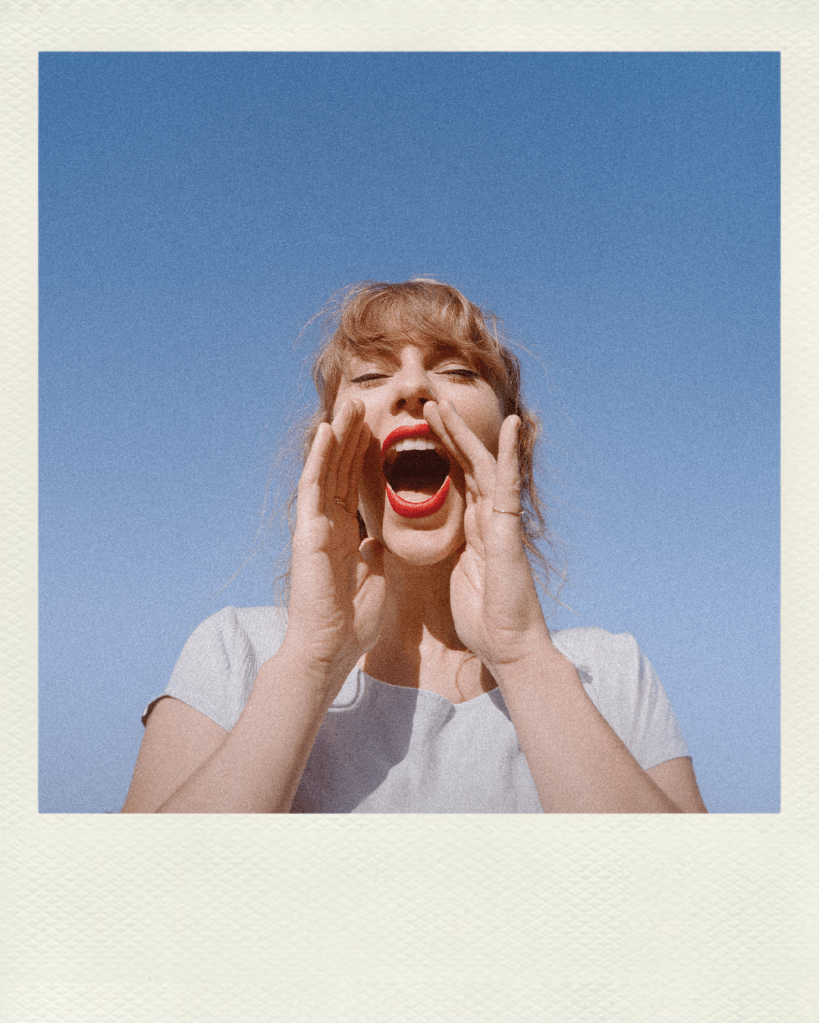
“Taylor taught me how to say my name louder.”
Kindergarten me thought school was a magic trick; grown‑up me thought teaching was the same trick reversed. Somewhere between those two pictures I found Taylor Swift on a mixtape and then on a baby blue CD and then on every playlist that kept me from dissolving the night I told my family I was gay. Her songs showed up like a friend who knew exactly what to say—wordy, precise, dramatic, and somehow kind—so I learned to use her language when my own felt too small.
Lyrics As Maps:
Taylor’s lines give you directions when the path feels invisible. Her songwriting reads like a mapmaker’s notebook, giving you street names for feeling—“the story of us,” “cardigan,” “the lakes”—so when I was fumbling through coming out and career shifts, I could point to a lyric and know I wasn’t inventing my experience. That specificity matters. In “You Need to Calm Down” she names the target and then folds the chorus into a collective who‑we‑are, and in quieter songs like “Illicit Affairs” or “Exile” she renders the ache in a way that makes it possible to name yours. When you don’t have a vocabulary for what’s happening to you, a Taylor line will hand it to you in full, dramatic sentences.
Community and Visibility:
Swifties are a messy, loving newsroom. Being a Swiftie isn’t just stan culture, it’s crowd therapy. The fan base has been one of the safest rooms I’ve ever entered—people sharing stories about coming out at concerts, sending fans art that reads like confessions, and turning lyrics into little queer anthems. Taylor’s public moves—calling out homophobia, supporting the Equality Act, and making “You Need to Calm Down” a literal call for visibility—gave the fandom permission to be loud. That visibility matters in real life: when I saw trans and gay fans at shows holding signs that said, “We make it to the bridge together,” it was less about celebrity and more about being counted.
Activism and Donation:
When the pop star becomes a literal ally… It’s one thing to sing about inclusion and another to write checks and sign letters. Swift’s donations to organizations like GLAAD and the Trevor Project, plus her vocal support for legal protections, moves her beyond symbolic solidarity. For people who didn’t have a big community safety net, those actions were tangible. They meant resources, hotlines, and a megaphone pointed at systems that make life harder for queer people. For me, knowing a major artist used her platform that way lowered the background noise of shame and isolation just a few decibels, which in a dark season felt like life support.
Why this Matters to Me:
Taylor’s songs were scaffolding while I rebuilt myself… as I continue to. They help me narrate who I am during shifts big and small—leaving a job, rewriting a family story, or finally saying the word out loud. Beyond the celebrity gloss, her work gives me language to call out cruelty and a chorus to sing back when I feel unseen. That’s why I can be sentimental but still roll my eyes at her industry theatrics—she’s given me something more useful than a headline. She’s handed me a way to speak.
Sing Loudly and Bring Someone with You:
If a line struck you the way it struck me, post it. Make a playlist for someone who’s having a hard week. If you’re a Swiftie, share a moment where a song got you through something—tag it #BlankSpacesAndPolaroids or just send it to one person who needs to hear it. If you’re new to her music, try a deep cut on a slow afternoon and see what names it gives you.
Either way, don’t keep the good lines to yourself—pass them on.
 Blank Space & Polaroids
Leave a comment